Future of Us

where civic imagination, insights, and infrastructure meet

Donate

The Visions · The living archive

Hall of Anythings

Browse the future worlds we heard imagined across the country, brought to life through art and story.

Free to explore, download, and share.
  • Illustrated by Yuko Okabe

  • Illustrated by Kate Medina

  • Illustrated by Kaeli McLeod

  • Illustrated by Catherine Wang

  • Illustrated by Grace Preston

  • Illustrated by Micheline Hess

  • Illustrated by Yuko Okabe

  • Illustrated by Grace Preston

  • Illustrated by Frank Myles

  • Illustrated by Yuko Okabe

  • Illustrated by Crys Ganatra

  • Illustrated by Crys Ganatra

  • Illustrated by Oak Bediako

  • Illustrated by Ania Siniuk

  • Illustrated by Oak Bediako

  • Illustrated by Kaeli McLeod

  • Illustrated by Micheline Hess

  • Illustrated by Ania Siniuk

  • Illustrated by Catherine Wang

  • Illustrated by David Dawkins

  • Illustrated by Ania Siniuk

  • Illustrated by Grace Preston

  • Illustrated by Frank Myles

  • Illustrated by Kate Medina

  • Illustrated by Frank Myles

  • Illustrated by Catherine Wang

  • Illustrated by David Dawkins

  • Illustrated by Kate Medina

  • Illustrated by Micheline Hess

  • Illustrated by Kaeli McLeod

  • Illustrated by Kaeli McLeod

  • Illustrated by Crys Ganatra

  • Illustrated by Micheline Hess

  • Illustrated by Frank Myles

  • Illustrated by David Dawkins

  • Illustrated by Yuko Okabe

  • Illustrated by Oak Bediako

  • Illustrated by David Dawkins

  • Illustrated by Oak Bediako

  • Illustrated by Crys Ganatra

  • Illustrated by Kate Medina

  • Illustrated by Grace Preston

  • Illustrated by Catherine Wang

  • Illustrated by Ania Siniuk

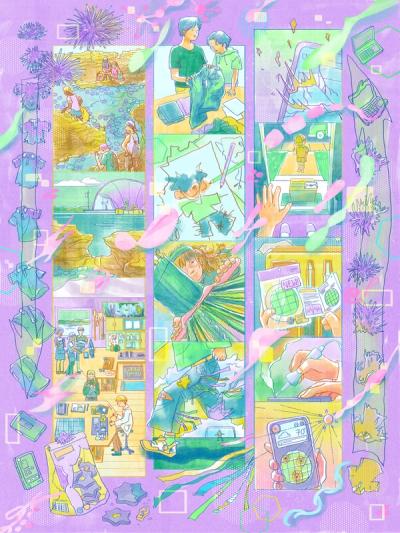
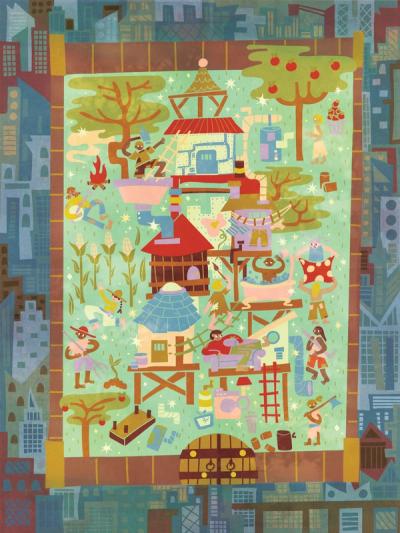
Artwork for “Waste Not, Want Not”

Green Futures Boston, MA · San Francisco, CA

Waste Not, Want Not

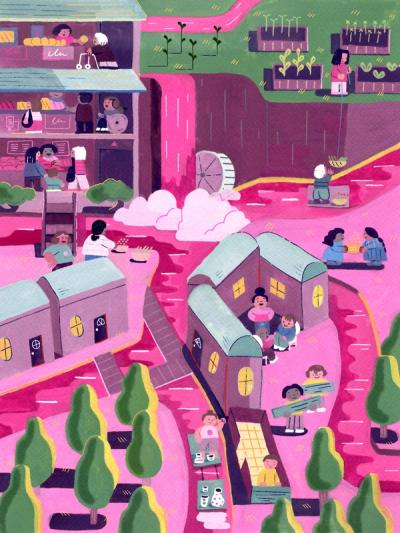
In this city, everyone learns materials science young — the way previous generations learned to cook. They especially learn about the materials around them, the local ecology and technologies, and all of the chemistries and materials that make it up. You study how materials break down, how they transform, what they can become. It’s a skill, like any other. When something breaks, you know how to fix it. When there’s surplus, you know how to use it. Nothing leaves the city without becoming something else... usually a few times

Kian works at the waste center, a vibrant, imaginative lab where people’s creativity, scientific and technical engineering are on full display. Kids come for tours, and it’s like a Willy Wonka world of reuse. Next up: thousands of invasive sea urchins are being culled from the bay, which is finally healing due to a breakthrough in technology to collect them en masse. Kian’s job is to figure out how to make the best use of them. He thinks in layers. What does the city need? What do we have? The shells are calcium carbonate, so that’s easy. They can calcine into aggregate for affordable housing, among countless other uses. The meat is protein-rich, but there’s too much of it to realistically consume as a delicacy, and it’s not particularly “snackable”. He realizes the protein could become flour — umami-rich, mineral-dense. It could go into sourdough, nutrition bars, and open food pantries. He creates a recipe for a delicious, earthy special-edition cookie that fills the shelves of the city’s cafes. The urchin overflow fills needs and creates joys

Across town, Lizzie’s fancy new foldable phone breaks. She pulls up the open-source repair database and finds three solutions designed by people in her city who’ve solved this exact problem. She picks one, orders the kit, repairs it herself. Everyone knows how. And bonus – the kit includes an upgrade module. She integrates it and discovers a few additional ways to enhance her functionality. Her phone isn’t just repaired — it’s better, personalized. She posts her solution to the community board

Eliza feeds her kids’ outgrown clothes into the home upcycler. It breaks the fibers down to their parts. She takes the sorted material to the community hub and meets Aisha, a textile artist. The kids sketch what they want. Aisha talks them through what’s possible. It costs less than new clothes in this world, and it supports a local maker. The kids watch their old clothes become exactly what they designed

In this city, nothing is disposable. Everything is material for the next thing. The work is never finished because the city keeps generating surplus, and everyone is trained not to consume, but to create – to see waste as opportunity

Illustrated by

Catherine Wang

A full list of the tour participants across the country who inspired this story, and gave their permission to be credited, is coming soon.