Future of Us

where civic imagination, insights, and infrastructure meet

Donate

The Visions · The living archive

Hall of Anythings

Browse the future worlds we heard imagined across the country, brought to life through art and story.

Free to explore, download, and share.
  • Illustrated by Yuko Okabe

  • Illustrated by Kate Medina

  • Illustrated by Kaeli McLeod

  • Illustrated by Catherine Wang

  • Illustrated by Grace Preston

  • Illustrated by Micheline Hess

  • Illustrated by Yuko Okabe

  • Illustrated by Grace Preston

  • Illustrated by Frank Myles

  • Illustrated by Yuko Okabe

  • Illustrated by Crys Ganatra

  • Illustrated by Crys Ganatra

  • Illustrated by Oak Bediako

  • Illustrated by Ania Siniuk

  • Illustrated by Oak Bediako

  • Illustrated by Kaeli McLeod

  • Illustrated by Micheline Hess

  • Illustrated by Ania Siniuk

  • Illustrated by Catherine Wang

  • Illustrated by David Dawkins

  • Illustrated by Ania Siniuk

  • Illustrated by Grace Preston

  • Illustrated by Frank Myles

  • Illustrated by Kate Medina

  • Illustrated by Frank Myles

  • Illustrated by Catherine Wang

  • Illustrated by David Dawkins

  • Illustrated by Kate Medina

  • Illustrated by Micheline Hess

  • Illustrated by Kaeli McLeod

  • Illustrated by Kaeli McLeod

  • Illustrated by Crys Ganatra

  • Illustrated by Micheline Hess

  • Illustrated by Frank Myles

  • Illustrated by David Dawkins

  • Illustrated by Yuko Okabe

  • Illustrated by Oak Bediako

  • Illustrated by David Dawkins

  • Illustrated by Oak Bediako

  • Illustrated by Crys Ganatra

  • Illustrated by Kate Medina

  • Illustrated by Grace Preston

  • Illustrated by Catherine Wang

  • Illustrated by Ania Siniuk

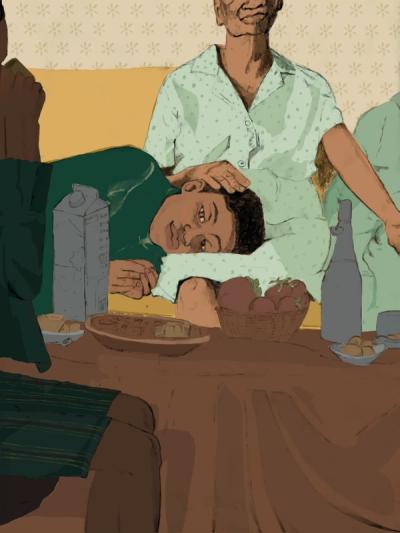
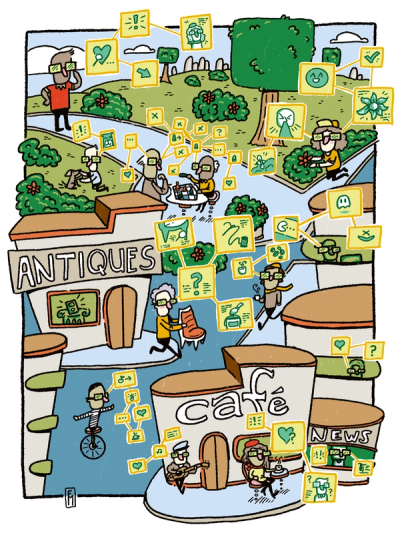
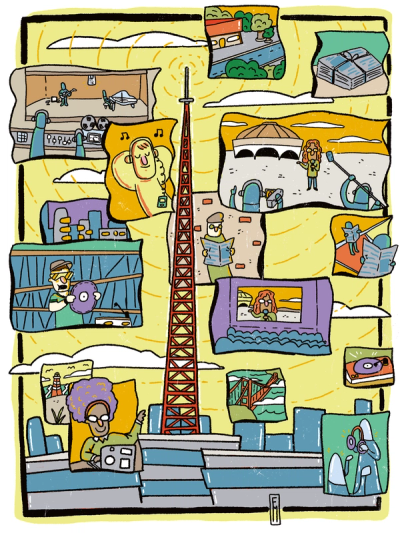
Artwork for “The Great Unflattening”

Media Futures Kansas City, KS

The Great Unflattening

For years, the country had flattened into a series of caricatures and media had become a sad, gray monopoly. Every city was presented as a one-dimensional version of itself, and the media system wasn’t honed to capture what made it special. People had started believing the flattened version of their own country: “not a lot going on in Nebraska”, “no culture in Iowa”, “San Francisco is out of touch

Eventually people got tired of being told who they were by people who’d never been there

Communities started picking up whatever equipment and technology they already had and telling their own stories instead. Public radio saw the opening and reinvented itself, no longer broadcasting one national voice but building space for the specific texture of each place. Local film crews followed. A retired teacher in Des Moines began recording farmers experimenting with regenerative grain. A documentarian in Tulsa followed a community garden that had fed half a neighborhood through a hard winter

A network grew around this work, equipping local creators across the country with the tools and support to tell their own stories well. And then those stories started moving. People in one city started to get curious about what people were like in another, and the media coming out of each place was so unique and creative, representing what made that community special, that it made it exciting to get to know each other again

It also encouraged each place to invest in and celebrate its own creative and cultural identity. Small cities started building reputations for their crafts: new folk scenes breaking out of unexpected towns, documentary festivals drawing crowds to places nobody used to stop, independent cinemas dark for years filling again with premieres

Then people wanted more than the stories. They wanted to go. Taste the barbecue in Memphis. See the wildflowers bloom across the Midwest at exactly the right week in spring. Spend time in the mountain communities of Appalachia, meeting the people whose voices they’d been hearing for months. It wasn’t tourism. It was exchange, and it allowed each place to invest more deeply in becoming the fullest version of itself

As more people wanted to move between these places, high-speed rail finally had a reason to get built that everyone could agree on. People wanted to get to Milwaukee by Friday night, and Kansas City the weekend after

Media had once flattened the country into something small, but it became its connective tissue: telling the real stories, place by place, that allowed the country to finally see itself

Illustrated by

Frank Myles

A full list of the tour participants across the country who inspired this story, and gave their permission to be credited, is coming soon.